Home/Robotic Knee Replacement in Mira Road
Robotic Knee Replacement in Mira Road, Mumbai
Robotic assistance is a genuine advance in knee replacement — and it is not necessary for every knee. This page explains what the technology actually does, which patients benefit most, what it costs in Mira Road, and where a well-executed conventional replacement remains the sensible choice.
The Technique
What Robotic Assistance Actually Does
The word “robotic” does a lot of damage to patient understanding, because it suggests a machine performing the operation. That is not what happens, and any surgeon who lets you believe it is doing you a disservice.
A robotic knee replacement begins with a CT scan of your leg, which is converted into a three-dimensional model of your own knee — your bone shape, your deformity, your alignment. The surgeon plans the operation on that model before entering theatre: implant size, rotation, position, and how much bone to remove to within a fraction of a millimetre.
In theatre, the robotic arm holds the surgeon to that plan. It provides a physical boundary so that bone preparation stays inside the planned envelope, and gives live feedback on ligament balance through the range of movement, so the plan can be adjusted with real data rather than by feel. The surgeon makes every decision and every cut. The robot removes variability from the execution; it does not replace judgement.
Why precision matters in a knee
A knee replacement is a mechanical bearing installed in a living limb. If the components sit a few degrees away from where they should be, load passes through the implant unevenly. In the short term that shows up as stiffness, a knee that never feels quite natural, or persistent pain with no obvious cause. Over many years, uneven loading is one of the drivers of accelerated polyethylene wear and early loosening. Alignment is not a cosmetic detail — it is the thing that decides how the joint feels and how long it lasts.
Honest Assessment
Who Genuinely Benefits — and Who Does Not
Robotic assistance is a real advance, not marketing. It is also not necessary for every knee, and it is worth saying so plainly. A well-executed conventional knee replacement in experienced hands gives an excellent result, and has done for decades. If a hospital cannot explain why your knee specifically benefits, that is a question worth pressing.
Where robotic planning earns its cost
- Significant deformity — marked bow-leg or knock-knee, where the correction is large and the margin for error narrower
- Unusual anatomy, or bone shape outside the range standard instruments assume
- Previous surgery or hardware in the same knee that distorts the usual landmarks
- Younger, higher-demand patients, where precise alignment has more decades to repay itself
- Partial knee replacement, where component positioning is less forgiving than in a total
- Revision surgery and complex reconstruction
Where conventional surgery is perfectly reasonable
- A straightforward arthritic knee with good bone stock and modest deformity
- Older patients with lower mechanical demand on the joint
- Where the additional cost would be a genuine hardship — the result from good conventional surgery is very good
- Where the surgeon is far more experienced with conventional technique — surgeon familiarity outweighs the tool
Here
Robotic Joint Replacement in Mira Road
Until recently, robotic joint replacement in Mumbai meant travelling to Andheri, Mulund or the island city — a journey undertaken with an arthritic knee, and then repeated for every follow-up and physiotherapy review. For many patients that travel is the hardest part of the whole process.
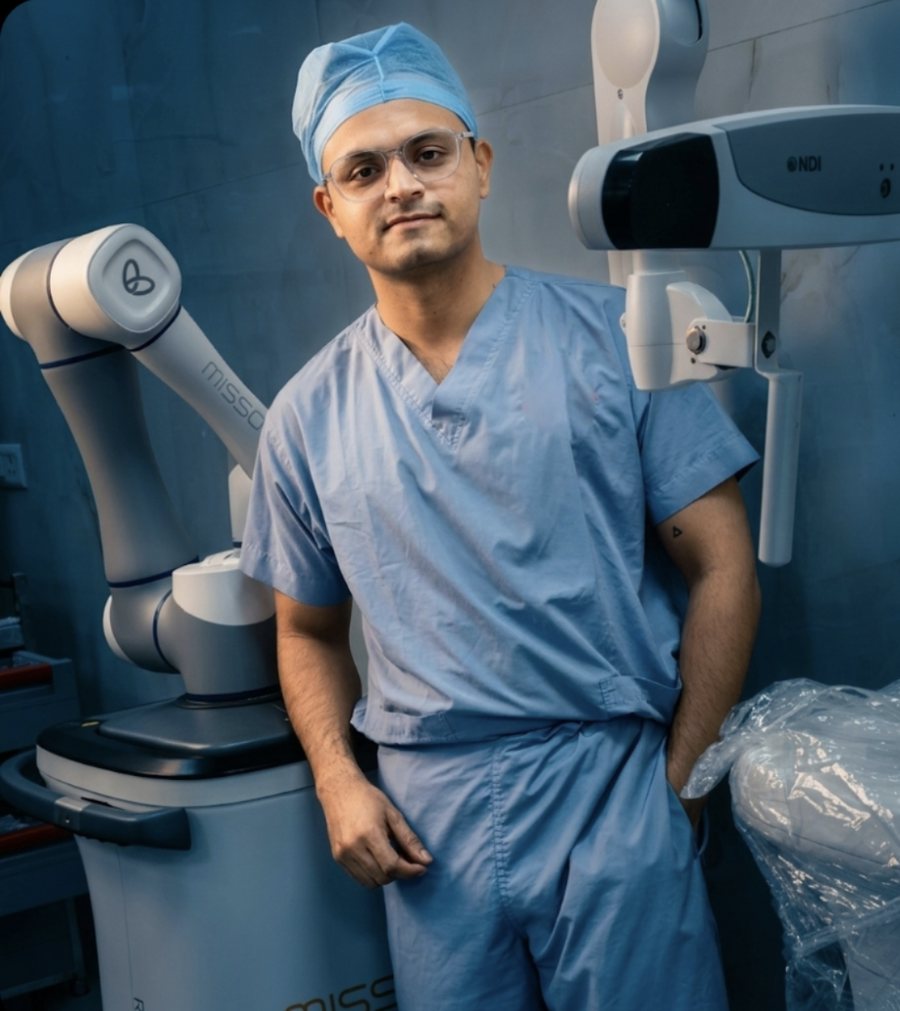
Dr. Avinash A. Kachare consults at Surgicare Plus in Mira Road East and operates at the associated hospitals in the area, including Wockhardt Hospital and Gurukripa Hospital, which hold the theatre infrastructure and robotic systems that joint replacement requires.
He performs MAKO and MISSO robotic-arm assisted knee replacement, operating with both the MAKO (Stryker) and MISSO systems.
The training behind it
Robotic technique is a fellowship-level skill, not a weekend course. Dr. Kachare completed a dedicated fellowship in robotic joint replacement and 3D printing at Queen Mary Hospital, University of Hong Kong, alongside an MS in Orthopedics from LTMMC & GH (Sion Hospital), a fellowship in arthroscopy and sports surgery in Hungary, and a fellowship in trauma and 3D printing. His published work is indexed on PubMed, including a paper on 3D-printed mesh implants for bone gap management in weight-bearing bone.
That last point matters more than it sounds. The same three-dimensional planning that drives robotic surgery also underpins 3D-printed patient-specific implants — used where bone loss, deformity or a failed previous implant means that no off-the-shelf component fits. Very few surgeons in the western suburbs work across both.
Surgicare Plus — Mira Road
Shop No. 40-41, Poonam Cluster 2
Mira Road East, Mira Bhayandar
Maharashtra 401107
Phone / WhatsApp: +91 94219 91530
Monday to Saturday
10:00 AM – 8:00 PM
Sunday — by appointment
Appointments are preferred, especially if you are travelling in from Vasai, Virar or Thane, or have difficulty standing for long.
Practical
Cost, Hospital Stay and Recovery
Robotic knee replacement in Mumbai runs approximately ₹3,50,000 to ₹5,50,000 for one knee, against roughly ₹1,50,000 to ₹3,00,000 for conventional. The difference covers the pre-operative CT and planning, single-use robotic instrumentation for your case, and the system itself. Most Indian health policies cover robotic joint replacement, though some cap the reimbursement at the conventional rate — confirm this with your insurer in writing before admission. The full cost breakdown for Mira Road sets out every component and what packages typically exclude.
Hospital stay is usually three to five days. Most patients stand and take a few supported steps on the day of surgery or the day after — early movement is not bravado, it is what protects against stiffness and clots. Walking aids are typically needed for two to six weeks, and the knee continues to improve for a full year. The week-by-week recovery timeline sets out what to expect at each stage.
Still weighing it up? The side-by-side comparison goes through the evidence for each technique without the sales pitch.
Robotic Surgery
Robotic Knee Replacement — Frequently Asked
Ask whether robotic surgery is right for your knee
WhatsApp Us